
On Doing Absolutely Nothing
A discussion of modern and ancient rest

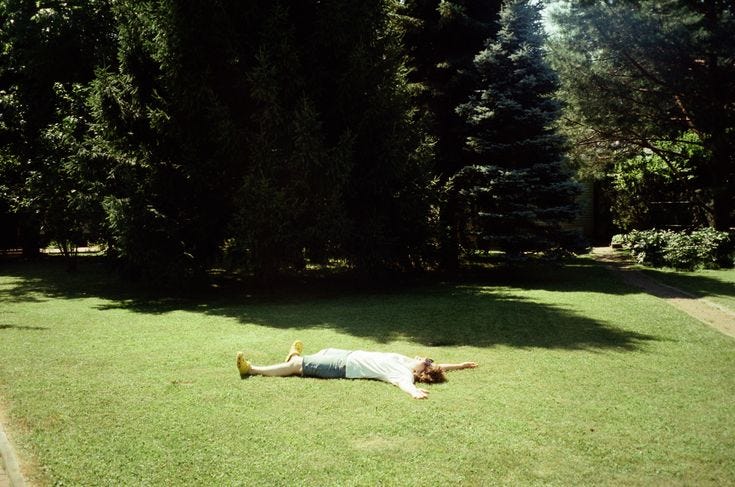
At the end of most yoga classes, they tell you to lie on your back, arms out, palms up. To be a body that is no longer doing anything. You don’t stretch or hold anything in, you don’t even try to relax in any particular way. This is corpse pose, “Savasana.”
By the time we get here, the room has seen every cycle of my temperament and then some. The mirrors are fogged just enough to make everyone look a little better than they probably do and everything smells faintly of eucalyptus and sweat. I’m lying on my back, which is apparently the point, staring up at the ceiling vents like they might tell me the secrets of the Nile if I watch them for long enough. The instructor tells us to “let everything go” which is a nice sentiment but also vague. How do I know if I’ve let go of everything? I can hear a woman breathing next to me like she’s in a movie about survival. And then there’s a moment where everyone settles, like we collectively decided to commit to this part where finally, nothing happens.
This is where the body is alleged to absorb the work we just did, and everything integrates (which sounds important, and sort of made up). My legs feel heavy. My hair is damp on the back of my neck, and a drop of sweat moving slowly toward my ear becomes the most important thing in the room.
I try to be still. I really do. But there is always something. An itch on my cheek, or the sudden awareness that I haven’t checked my phone in almost an hour. I open one eye for one second, just to see if everyone else is as committed to this as I am at least pretending to be. They are, or at least they’re really good at pretending.
I think this is what we call rest. It doesn’t always feel like rest though. It feels like waiting.
Like something is about to start again, even though it hasn’t been announced. The stillness is a form of suspense. I’m not done, just in between.
Maybe that is what rest has become. Something that exists in relation to what comes next. A way of organizing time so we can continue without feeling like we’ve skipped anything important. Even the language we use to describe rest is like that: recharge, reset, recover. It all points forward, it all points to motion.
Byung-Chul Han’s The Burnout Society references a shift in the collective psyche in which we have moved away from external pressure and toward a kind of compulsive internal performance of achievement, where an individual becomes both the one who demands and the one who complies. There is no clear boundary between effort and recovery because both of them serve the same system of achievement. Rest does not exist outside of productivity. It exists as a function within it. That might be why so much of what we call rest in the present day fails to feel truly restorative.
Memory researchers use the term consolidation to describe the process by which experience becomes more stable in the mind over time. Research suggests that even brief periods of quiet, waking rest after learning can improve recall, precisely because nothing new is crowding in too quickly (Wamsley, 2022). In other words: complete stillness and emptiness of stimuli is inherently beneficial for us. It allows the brain to stop rearranging and start actually retaining.
Over spring break, I tried to relax in ways that were supposed to work. Lying in the sun, long walks, sitting with a novel and nothing else to do. It all looked right. If someone had taken a picture of me, it would have been labeled as rest on the spot. But it didn’t feel like that. I felt like I was in the same mode of productivity, just without anything specific to apply it to. Like I was waiting to feel relaxed instead of actually being it. Even the effort to “slow down” had a kind of structure to it.
I didn’t really know what stopping felt like without turning it into something else.
So I started looking into the idea of rest. What had it meant to rest, before it became something to schedule or optimize? I started to run into the idea of the Sabbath, again and again.
One thing to know about Sabbath is that you don’t decide when it happens.
You stop because it is time to stop.
Not because you’re tired enough, or you’ve finished what you’re doing. Not because you earned it. It doesn’t really matter what the situation is at all. Whatever you were in the middle of, be it work, or any concentrated thought, just ends. Resting, according to Sabbath, does not result from how you felt, or how well you managed your time. It happens regardless.
Abraham Joshua Heschel describes the Sabbath as a “sanctuary of time,” which should break the linear experience of productivity and consumption most of us experience in the everyday. That feels different from anything I had been doing during this week of supposed “rest.” None of what I was calling rest actually interrupted anything.
And so I think back to Savasana.
Lying at the end of a yoga class, I seldom feel like everything stops. I feel more like I am waiting to get up. To resume life, abide by the next instructions. But a good corpse pose is not supposed to feel like that. True rest is not supposed to feel like that. Rest is about removing everything that keeps you in motion. It quiets the impulse to adjust and the need to process what may come next. It doesn’t ask for improvement or optimization. Just consolidation. For the body to catch up to what just happened. For the mind to follow.
The same thing seems to happen during the Sabbath. Rest is a forced interruption.
The Sabbath forbids 39 categories of tasks. These tasks are not all “work” in the obvious sense. They are acts of making, adjusting, carrying, completing. They suspend all ability to intervene in the world in all the ways we are used to. And without that, something else becomes unavoidable:
The mind finds the present.
Neuroscience explores this state through research on what is called the Default Mode Network. This is the cognitive system which activates when there is no external task to focus on. The mind has the chance to turn inward, into a continuous, self-referential state. The Default Mode Network is a pivotal player in social cognition, memory, and emotional processing.
This is what Savasana triggers once you stop trying to get it right.
Lying there, the body settles. Nothing tangibly improves or resolves. There is no outward expression of your achievement of rest.
The Western culture presently treats rest as something to add into the day. A yoga class was taken. A walk scheduled. A cup of tea brewed and enjoyed. It becomes another activity, another small project to get right.
But ancient rituals argue that actual relaxation has less to do with adding things and more to do with stripping back the things that keep you from sitting still.
Not doing rest better. Just committing entirely to a moment of doing nothing, so the body and mind have space to settle.
References:
Azarias, Almeida, de Melo, Rici, Maria. The Journey of the Default Mode Network: Development, Function, and Impact on Mental Health. National Library of Medicine (2025). https://pmc.ncbi.nlm.nih.gov/articles/PMC12025022/
Han, Byung-Chul. The Burnout Society (2010)
Heschel, Abraham Joshua. The Sabbath: Its Meaning for Modern Man (1951)
“Savasana Definition & Meaning.” Merriam-Webster, Merriam-Webster, www.merriam-webster.com/dictionary/Savasana
Wamsley, E.J. Offline memory consolidation during waking rest. Nat Rev Psychol 1, 441–453 (2022). https://doi.org/10.1038/s44159-022-00072-w